Park and Hill North Country Cheviots: What’s the Difference?
For anyone new to the North Country Cheviot, one of the first points of confusion is that there are two recognised varieties within the breed: the Park type and the Hill type. Both are true hill sheep, bred to thrive in exposed, marginal environments and to rear strong, commercial lambs under demanding conditions. However, there are important differences between them that may influence which type best suits a particular system or breeding objective.
Breed Characteristics
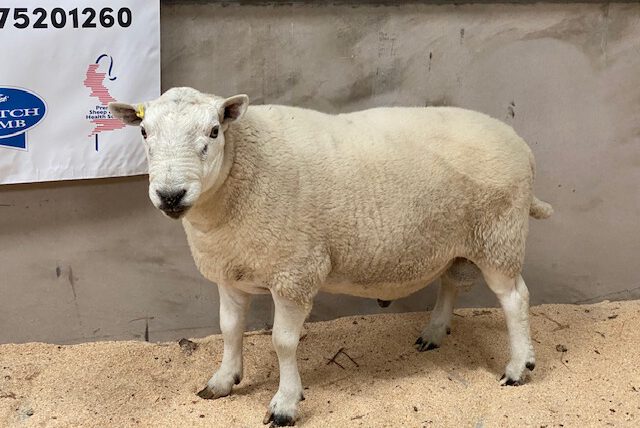
Regardless of type, the North Country Cheviot is easily recognisable. The head should be white and well covered with fine hair, free from brown or bluish tinge. Ears are of moderate length and thickness, well haired, and carried at roughly a forty-five degree angle from the horizontal, with good width between them. The nose is straight to slightly Roman, with good width between the eyes, a broad muzzle and wide, open black nostrils. The head is long with a pronounced undertow, and the eyes are dark, bright and alert. Wool should come up to the back of the cheeks, under the throat and behind the ears, but not between them. Rams may be horned, though horns must be free from blackness.
The neck is strong and well set into the shoulders. The body should be long, deep and wide, with a straight back, good width between the shoulder blades and no slackness behind them. The breast is deep and wide, ribs well sprung, and the tail broad and well woolled. Legs are white, of fair length, set squarely beneath the body, with strong, flat bone and well-defined hocks. Hooves should be black and durable. The fleece is white, of good staple length, free from hair, curl or kemp, and should have a soft, spongy handle rather than a harsh feel.
While both Park and Hill types share these fundamental breed characteristics, their development in different environments has shaped their size, frame and commercial emphasis.
The Hill Type (Lairg Type)
The Hill type North Country Cheviot, sometimes referred to as the Lairg type, was developed on the rugged hills of Sutherland. It is, in every sense, a mountain sheep.
Slightly smaller and lighter than the Park type, the Hill Cheviot is nevertheless the largest of the recognised UK hill breeds. It has been bred first and foremost for hardiness, maternal ability and the capacity to perform in harsh, exposed conditions. Hill type ewes are well known for lambing outdoors with minimal assistance and for rearing strong lambs on challenging ground without excessive intervention.
Over generations, careful selection has refined conformation and uniformity, but the essential priorities remain vigour, health and practicality. The Hill type is bred with commercial realities in mind: a ewe must thrive where she is put, rear a quality lamb and maintain condition under pressure.
Draft Hill ewes are also highly valued. Typically sold around five years of age, they often go on to produce several further crops of lambs on lower ground, demonstrating longevity and continued productivity.
The Park Type
The Park type North Country Cheviot was developed on the richer, more fertile land of Caithness. As a result, it is generally larger and heavier than the Hill type, with more scale and frame.
This additional size is frequently passed on to progeny, whether bred pure or used in crossbreeding systems, often resulting in an uplift in value for both prime and store lambs. For producers seeking extra weight and growth while retaining the Cheviot’s hardiness and maternal qualities, the Park type offers clear advantages.
Although more commonly associated with slightly lower and better ground than the Hill type, the Park Cheviot remains a genuine hill sheep. It retains the breed’s trademark vigour and resilience and is capable of thriving in remote and demanding environments. Park ewes are reliable outdoor lambers, requiring little intervention and demonstrating strong mothering ability.
Like their Hill counterparts, Park type draft ewes are much sought after. Once moved onto lower ground, they can continue producing two, three or even four additional crops of lambs, meaning that over the course of their working lives they may rear eight or nine crops in total.
Choosing Between Park and Hill
Both types share the same breed foundation and both are capable of producing high-quality, commercially relevant lambs under challenging conditions. The choice between them ultimately depends on land type, management system and breeding objectives.
For more extreme hill environments where resilience and thriftiness are paramount, the Hill type remains a proven and dependable option. Where ground allows for slightly more scale and growth, and where additional size in the lamb crop is desirable, the Park type may be better suited.
In either case, the North Country Cheviot continues to justify its reputation as one of the UK’s most robust and commercially valuable hill breeds.